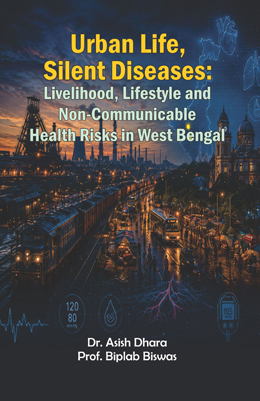
Urbanisation has transformed everyday life across India. Cities offer opportunities for employment, education, mobility, healthcare, communication and social advancement. At the same time, changing occupations, sedentary routines, dietary transition, stress, environmental exposure, unequal housing conditions and limited opportunities for physical activity have created new health challenges. Among the most important of these challenges is the growing burden of non-communicable diseases.
Urban Life, Silent Diseases examines the relationship between urban livelihood, lifestyle and non-communicable disease risks in West Bengal. The book focuses particularly on hypertension and diabetes, while also locating these conditions within the wider context of cardiovascular diseases, obesity, unhealthy diet, tobacco use, alcohol consumption, physical inactivity and socio-economic inequality.
The study is based on a comparative analysis of two important urban centres of West Bengal Asansol and Burdwan. These cities represent contrasting forms of urban development. Asansol has a strong industrial, mining, transport and commercial base, whereas Burdwan has a more administrative, educational, service-oriented and regional urban character. By comparing these two settings, the book demonstrates that urban health risks are not distributed uniformly. They are shaped by occupation, income, gender, physical activity, housing, food practices, body mass index, access to services and the nature of everyday urban life.
The book uses primary field-survey data collected through the WHO STEPS framework, along with secondary data from Census of India reports, health agencies and urban development institutions. It applies descriptive analysis, comparative interpretation, spatial understanding and Artificial Neural Network modelling to identify the major factors associated with non-communicable disease prevalence among city dwellers.
A major contribution of the book is its effort to move beyond the simple rural-versus-urban comparison. Rather than treating cities as a single health category, it studies differences within cities. It asks how people living in the same urban area may experience very different disease risks because of their occupation, social position, income, physical activity, housing quality, food environment and exposure to stress.
The book is relevant to researchers, students, public-health professionals, geographers, urban planners, municipal authorities, policymakers and development practitioners. It provides evidence for the need to integrate preventive health into urban planning and development. It also highlights the importance of community screening, active living, healthier food environments, workplace health programmes, improved sanitation, public awareness and equitable access to primary healthcare.
The work is also linked with the Sustainable Development Goals. It contributes directly to SDG 3: Good Health and Well-Being by focusing on prevention and control of non-communicable diseases. It also relates to SDG 11: Sustainable Cities and Communities by showing that city design, mobility, public space, housing and infrastructure influence health. Its discussion of inequality, nutrition, sanitation, work and institutional collaboration further connects with SDGs 2, 6, 8, 10 and 17.
Urban Life, Silent Diseases argues that a healthy city cannot be judged only by its economic growth, roads, industries or buildings. It must also be evaluated through the everyday wellbeing of its residents. The book therefore presents public health as an essential dimension of sustainable and inclusive urban development.
| Weight | 0.500 Gm. |
|---|---|
| Year | 2026 |
| Pages | 180 |
| Edition | Hard Bound |
| Author | Dr. Asish Dhara & Prof. Biplab Biswas |
256-bit SSL checkout with trusted payment gateways.
Pan-India delivery with reliable tracked couriers.
Straightforward return policy on eligible titles.
We're here Mon–Sat to answer your queries.